Professional Activities | ||||||||||||||||
| News Flash: I have left FOX5 Atlanta, WAGA-TV after over 10 years, and am moving to Houston, Texas, where I will be News Operations Manager at KTRK-TV. More details when I have time. (9 April 2006) | ||||||||||||||||
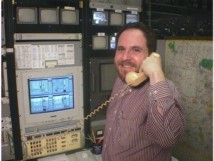
I'm News Operations Supervisor for FOX5, WAGA-TV Atlanta, Georgia. What's that mean? Good question, and sometimes I'm not so sure myself! Mainly I'm responsible for the live capability of FOX5 News (microwave Electronic News Gathering, or ENG, and Satellite News Gathering, or SNG). I'm also involved with computer systems, new technology, and other fun toys. For a humorous take on promoting local television news, listen to TV Sweeps From Hell by voice over artist Charlie Van Dyke. One of my ongoing projects is an Intranet for our newsroom. This "web portal" comes up as the starting page on all newsroom computers, providing a consistent interface for all users accessing the Internet. (The research page on this site is based upon and old version of part of the Intranet. Yes, it needs to be updated!)
Most of our microwave ENG is done on the 2 GHz band. Television stations share a limited number of channels. We coordinate our operation through so called "Gentlemen's Agreements" and "Home Channel Plans." In most of the USA this coordination is done through the Society of Broadcast Engineers. And, since no one else was willing to do it, I'm the SBE coordinator for frequencies above 1 GHz for North Georgia. The Atlanta 2 GHz sharing plan is probably typical of what is done in most of the country. Of course, the sharing plan must take into account the needs of all television broadcasters in a given area. In areas with more stations, like New York, stations may be primary users of at most one channel. One of my interests is promoting safety for technicians, photographers, reporters, and engineers operating in and around television Live Trucks. See my 1997 Radio World article, On Remotes, Look Up and Live. I'm also the webmaster for the Atlanta Section, Society of Motion Picture and Television Engineers. How did I get into television? Well, like many others in TV, I don't know what I want to be when I grow up. OK, seriously, here's the story. I've been an Amateur "Ham" Radio Operator since 1971, when I was twelve. Along the way I also earned an FCC First Class Radiotelephone Operator license, which used to be required for many jobs in television and radio broadcasting. When I was in Tucson, for college, I needed a job, and I'd always wanted to work in television. So I went knocking on TV station doors, saying "I have a license, can I have a job?" Ralph Turk, then Assistant Chief Engineer (later Chief, now retired) at KVOA-TV hired me for weekend master control, and the rest is, as they say, history. Among the professional organizations to which I belong:
•  � Copyright 2008 Andrew R. Funk • All Rights Reserved See Copyright, Linking and Content page for disclaimers and other information regarding this site!
| ||||||||||||||||